An old client of ours got in touch. We had previously worked with them on building their UK restaurant brand and growing them in search. Since then, they have merged with an international brand and were in the process of a rebrand and migration.
That migration hadn’t gone as well as expected, so they wanted another set of eyes on the project to see if there was anything else that could be done.
We helped them with a current situation analysis, tactical approach to key issues and ongoing plan for them to improve with.
Where were we?
Comparing a five-week window before the migration to the same window after it, expected organic traffic was down around 60%.
The local city pages, the pages that actually drive bookings, were hit hardest of all. Year-on-year, keyword rankings for individual locations fell between 30% and 70%, whilst expected organic traffic to those same pages fell by 78% to 97%. Two of the six city pages even gained keywords year-on-year and still lost the vast majority of their traffic. A sign the new pages were ranking, just for the wrong, lower-value terms.
Finding the “why”
None of that happens by accident, and none of it needed guesswork to explain. A page-by-page technical review turned up a cluster of compounding issues: location pages that had quietly been set to noindex; internal redirect chains stacking three hops deep, bleeding link equity at every jump; roughly twenty old URLs (worth around 8,000 monthly visits and 600 ranking keywords on their own) misrouted into redirect loops, dead ends or straight 404s.
The biggest issue though, was a site-wide entry popup covering most of the viewport for users and crawlers alike. This made sense as it explained the change but it also blocked the bulk of the content from crawlers.
And it wasn’t just on-site. A backlink comparison showed the new domain sitting on roughly 1,900 backlinks from under 500 referring domains, against 17,000+ backlinks from over 1,100 domains on the old one, even with correct redirects in place. Only around 40% of the sites that used to link directly to the old domain have updated to link to the new one; the rest are still relying on the redirect doing the work for them, silently, forever. Meanwhile, several high-authority directory listings and press write-ups out there still show the old domain and even the old phone numbers.
Why this is the useful bit
It would be easy to look at a 60-90% drop across the board and treat it as a crisis with no clear cause. It isn’t. Every one of those numbers traces back to something specific and fixable: an indexation setting, a redirect chain, a missing nav link, an out-of-date citation.
That’s the value of a proper current-situation audit, not reassurance, but a prioritised list of exactly what broke and in what order to fix it.
The plan from here is unglamorous but concrete: clean up the redirect chains, decide which “removed” pages genuinely deserve to stay out of the index versus which ones just need restoring, rebuild the internal linking that used to carry weight to the local pages, and work through the backlink and citation gap one high-value listing at a time.
This is exactly the kind of unsexy, sequential fixing (recently seems to be our specialty…) that turns a migration crisis back into a migration that just took a few weeks longer than hoped.
The Initial Results
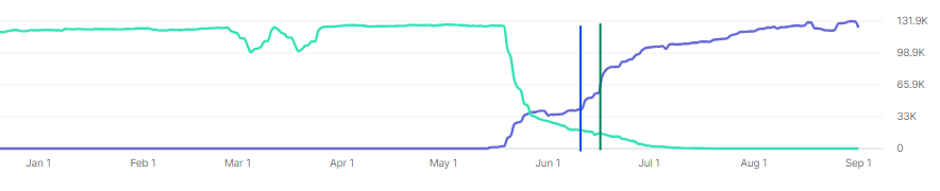
Whilst the plan is still ongoing, we have seen really strong improvements that have put expected organic traffic back where they used to be.
Two key changes lead to this with fixing broken links (blue line) and removing the pop up (green line) having a major impact.
Sometimes, the best SEO work isn’t flash or working with “brand new” techniques and tools, its about doing the basics really really well.